|
|
US & USSR: Relations Launch
|
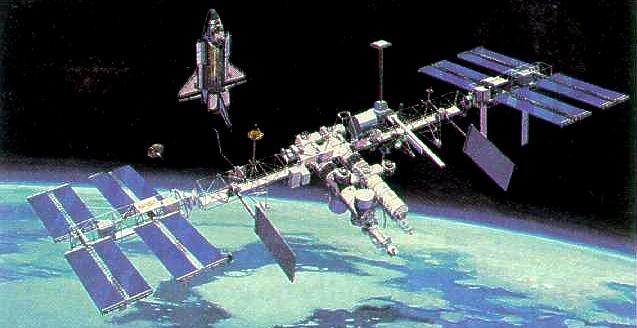
Space station Freedom |
With commendable boldness, President Clinton, Vice President Gore, and NASA Administrator Dan Goldin negotiated the alliance of the Russian Mir space station program with the Freedom space station project of America, Japan, Canada and the European Alliance. From both sides, this is a historical breakthrough. The space station merger marks the Clinton administration's major innovation in national security policy with respect to Russia. The joining of the Russian and American piloted space flight efforts represents a new partnership between former adversaries. During the Cold War, the Space Race represented the contest for space. There is no better way to show the fundamental change in the relationship between America and Russia than cooperation in human space flight. |
| Conceived in the Reagan administration as a means of demonstrating the superiority and solidarity of the Western Alliance, space station Freedom was the beginning of the end of the Cold War. Under the Bush administration, space technicians sought to justify the projected scientific and commercial grounds, with not much success. The cancellation of the space station was just waiting to happen. Russian participation in the space station will reduce the burden to America, while permitting speeding up progress toward the project's completion. |
| With the end of the Cold War, this broad political consensus dissolved. Though committed advocates of space exploration and development remained supportive, others began to question the need for continued relations. With the integration of Russia into the international space station effort, a post-Cold War geopolitical rationale for human space flight had been restored. At the mid-December 1993 meeting between Vice President Gore and Russian Prime Minister Victor Chernomyrdin, America and Russia formally agreed to join their space station efforts. This agreement was the culmination of an 18-month process that began in with the October 1992 Bush administration initiative for an exchange of American and Russian crews, and a flight of a shuttle to dock with Mir. |
American and Russian space adventurers share a meal during one of the link-ups of Mir with an American shuttle |
|
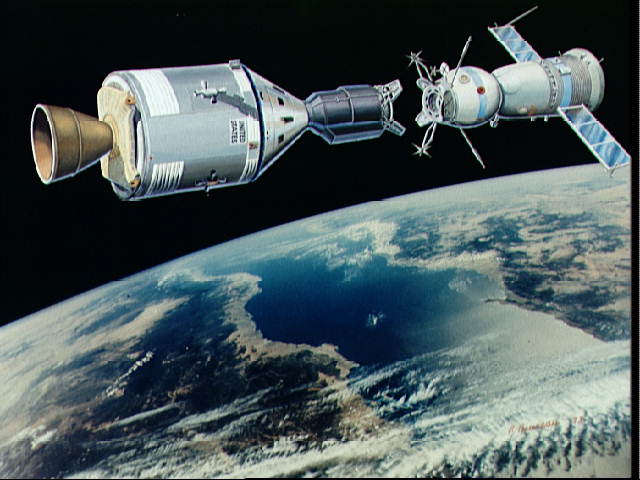
A picture of the Apollo-Soyuz link-up
in 1975. This was the first |