|
|
In the Beginning...
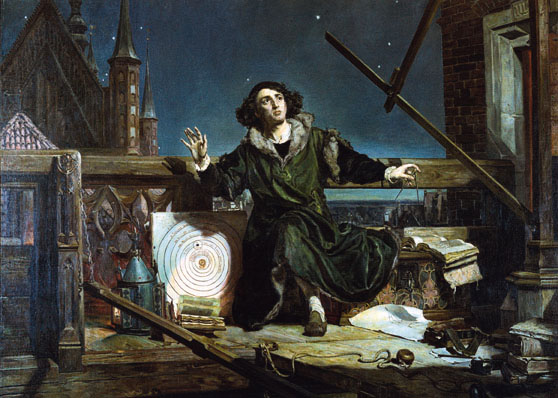
It was originally conceived that we live in a geocentric universe, which meant that Earth was the center of the universe. After much speculation and arguing, the heliocentric system, which is scientifically correct, was hypothesized by Polish astronomer Nicolaus Copernicus. That idea says that the sun is stationary and the Earth revolves around it, not the other away around.
Copernicus
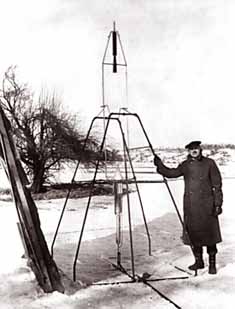
Unlike the enormous, complex equipment of today used to propel rockets into space. The first liquid fueled rocket was created by Robert Goddard and launched in Auburn, Massachusetts in 1926. Although the event went virtually unnoticed at the time, it is now thought as the beginning of the space age. As Goddard made this achievement, other engineers were preforming some of the same experiments. Hermann Oberth in Germany had detailed ideas about space travel but no actual rockets of equipment. K.E. Tsiolkovskii in the USSR very early created detailed theories on multi-stage rockets and their many systems which very closely parallel the realty of space flight later in the 20th century.
Goddard and his Rocket
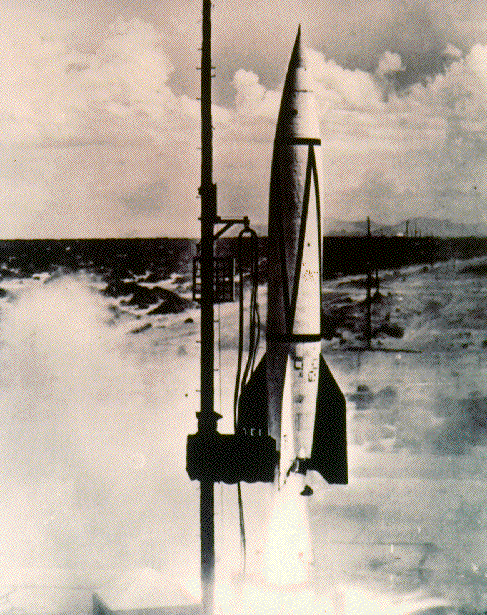
During World War II the three countries most advanced in rocketry, the United States, the USSR and Germany, used their technology to create weapons, this provided much needed funding for engineers like Goddard. But it also paved the way for a much more anonymous and efficient way of killing thousands, this misuse of the newly discovered rocket technology is seen in the creation of the German V-2 rocket which was used against England killing 2500 people. After the Allied powers victory in Europe the Soviet Union and the United States took full advantage of Germanys engineers and technology. As the United States and the Soviet Union became more and more opposed in their views, the competition of who would claim the skies grew, marking the beginning of the space race.
V-2 Rocket